Physics > Modern Physics > Dual Nature Of Radiation And Matter
Success Rate: 0%
Comprehension Passage
**Case Study: Photoelectric Effect**
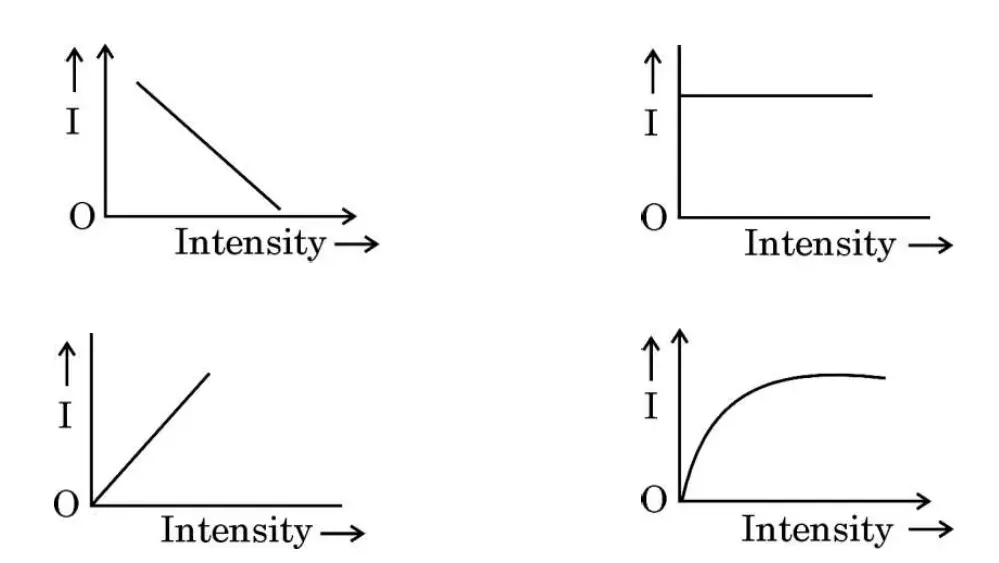
Einstein explained the photoelectric effect on the basis of Planck''s quantum theory. Light travels as discrete packets or photons of energy $h\nu$. The number of photons incident per unit time per unit area (intensity) determines the magnitude of the photoelectric current.
When a photon is incident on a metal surface, it transfers all its energy $h\nu$ to a free electron. A portion of this energy is used to overcome the surface barrier (known as the work function, $\phi_0$), and the remaining energy appears as the maximum kinetic energy ($K_{max}$) of the emitted electron. This relationship is defined by Einstein''s photoelectric equation:
$$K_{max} = h\nu - \phi_0$$
Comprehension Question 1
Which of the following correctly describes the variation of photoelectric current with the intensity of incident light?
Current Question
Attempts0/3
StatusNot Answered
Ready to Answer! 🚀
Community Stats
Active Learners31
Questions Attempted604
Community Success Rate70%
Track Your Progress
Sign up to save your practice progress, add favorites, and get personalized insights.

Edvaya Target
Practice Questions & Mock Tests
Improve your problem-solving skills with our extensive collection of practice questions including PYQs, NCERT Textbooks, NCERT Exemplars and Mock Tests. Get instant feedback and detailed solutions to enhance your preparation.