Home

Designed for school students & undergraduate entrance aspirants preparing for board exams, NEET, JEE and more.

JEE (Mains & Adv)NEET (UG)CBSE BoardISC BoardUP BoardCUET

Built for graduates & professionals targeting competitive exams — UPSC, CAT, GMAT, GRE, IELTS, banking & more.

GREGMATCATUPSCIBPSIELTSTOEFLSATACT

Core school & undergraduate subjects aligned with CBSE, ISC, UP Board, NEET and JEE syllabi.

PracticeMock TestsResources
Back to Categories
Question 1 of 40

Mathematics > trigonometry > Inverse Trigonometric Functions

Progress: 0%
Success Rate: 0%
Question 1

Case Study - 3

If a function f:X→Yf:X \to Y defined as f(x)=yf(x)=y is one-one and onto, then we can define a unique function g:Y→Xg:Y \to X such that g(y)=xg(y)=x, where x∈Xx \in X and y=f(x)y=f(x), y∈Yy \in Y. Function gg is called the inverse of function ff.

The domain of sine function is RR and function sine: R→RR \to R is neither one-one nor onto. The following graph shows the sine function.
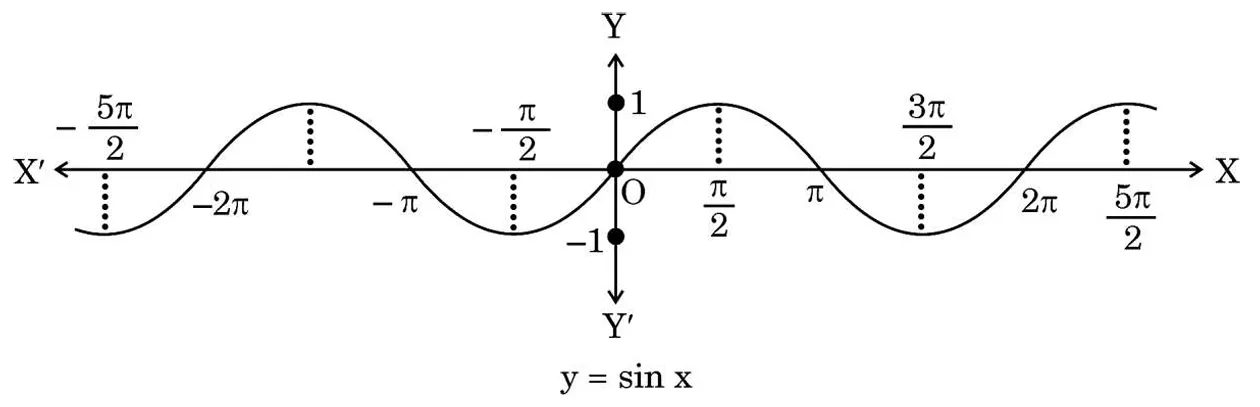
Sine Graph

Let sine function be defined from set AA to [−1,1][-1, 1] such that inverse of sine function exists, i.e., sin⁡−1x\sin^{-1}x is defined from [−1,1][-1, 1] to AA.

(ii) If sin⁡−1(x)\sin^{-1}(x) is defined from [−1,1][-1, 1] to its principal value branch, find the value of sin⁡−1(−12)−sin⁡−1(1)\sin^{-1}\left(-\frac{1}{2}\right) - \sin^{-1}(1).

0 of 40 answered

Current Session

Questions Answered0
Correct Answers0
Session Success Rate0%
Ready to Start! 🚀

Community Stats

Active Learners31
Questions Attempted604
Community Success Rate70%

Track Your Progress

Sign up to save your practice progress and get personalized insights across all topics.

We Value Your Privacy

Edvaya uses cookies to enhance your learning experience, analyze platform usage, and provide personalized content. You can customize your preferences or accept all cookies to continue.

By continuing, you agree to our Cookie Policy and Privacy Policy