The First Law of Thermodynamics is the law of energy conservation applied to thermodynamic systems: energy cannot be created or destroyed, only converted between heat and work and stored as internal energy. Its mathematical form, , is deceptively simple — but its application across five distinct thermodynamic processes (isothermal, adiabatic, isochoric, isobaric, and cyclic) generates a rich set of formulae, – curves, and conceptual distinctions that together form the most heavily tested part of the thermodynamics chapter in JEE and NEET. Mastering this topic means being able to identify the process from the – diagram, apply the correct formula, and compute , , and for each case.
1. First Law of Thermodynamics
where = heat absorbed by the system, = work done by the system, = change in internal energy.
- Sign convention (NCERT): when heat flows into system; when system does work (expands).
- is a state function (path-independent); and individually are path-dependent.
- = area under – curve.
- For a cyclic process: → (net heat absorbed = net work done).
2. Isothermal Process ( = constant)
- Condition: Temperature constant → for ideal gas, (Boyle's Law).
- Internal energy change: (ideal gas — depends only on ).
- From First Law: (all heat absorbed is converted to work).
- Work done:
– curve: Rectangular hyperbola ().
Example: For 1 mole at , doubling the volume: .
3. Adiabatic Process ( = 0)
- Condition: No heat exchange with surroundings () — thermally insulated system or very rapid process.
- From First Law: (work done by gas comes entirely from internal energy).
- Expansion: Gas does positive work → → temperature decreases.
- Compression: Work done on gas → temperature increases.
Adiabatic relations for ideal gas:
Work done in adiabatic process:
– curve: Steeper than isothermal curve (same starting point) because .
Comparison: Isothermal vs Adiabatic
| Property | Isothermal | Adiabatic |
|---|
| Constant | Changes |
| (non-zero) | |
| | (non-zero) |
| – relation | | |
| Slope of – curve | (less steep) | (steeper) |
| Speed of process | Very slow (isothermal) | Very fast (sudden) |
4. Isochoric Process ( = constant)
- Condition: Volume constant → (no expansion work).
- From First Law: (all heat goes into changing internal energy).
- Ideal gas: (Gay-Lussac's Law); .
- – curve: Vertical line (volume doesn't change).
5. Isobaric Process ( = constant)
- Condition: Pressure constant → .
- Ideal gas: (Charles' Law); ; .
- From First Law:
- – curve: Horizontal line (pressure doesn't change).
6. Cyclic Process
- System returns to its initial state → .
- From First Law: (net heat absorbed = net work done by system).
- – curve: Closed loop; area enclosed = net work done.
- Clockwise cycle → positive area → net work done by system (heat engine).
- Anticlockwise cycle → negative area → net work done on system (refrigerator).
7. Quick Revision — Five Thermodynamic Processes
All five key thermodynamic processes, their – curves, and the key equations for each.
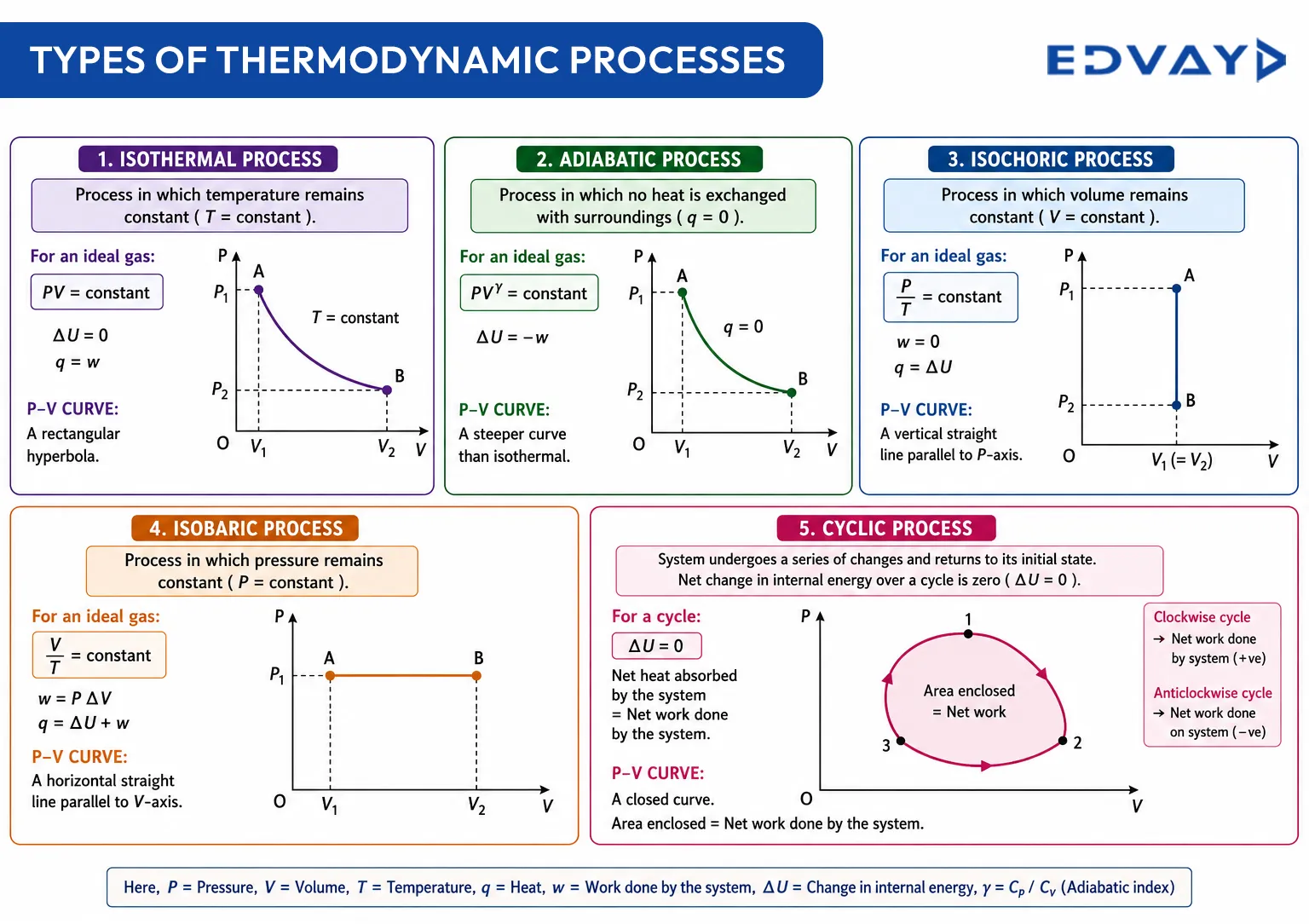
All five thermodynamic processes — PV curves, key equations, and process conditions at a glance.
8. Master Summary Table — All Five Processes
| Process | Condition | | | | – curve |
|---|
| Isothermal | | | | | Hyperbola |
| Adiabatic | | | | | Steeper hyperbola |
| Isochoric | | | | | Vertical line |
| Isobaric | | | | | Horizontal line |
| Cyclic | Returns to initial state | = Area of loop | | | Closed loop |
Practice Questions
Q1 (JEE Main / NEET): An ideal gas expands isothermally from volume to at a temperature of 300 K. If mol, find the work done and heat absorbed.
Explanation:
For an isothermal process involving an ideal gas, the temperature is constant, so the change in internal energy is zero ().
Work done () is calculated as:
According to the First Law of Thermodynamics ():
(heat absorbed from surroundings).
Q2 (JEE Main): A gas is compressed adiabatically. Which of the following is correct?
A) ,
B) ,
C) ,
D) ,
Answer: B) , .
Explanation: By definition, an adiabatic process exchanges no heat with the surroundings, so . Since the gas is being compressed, work is done on the gas, making negative ().
Using the First Law of Thermodynamics ():
Therefore, , meaning the internal energy and temperature of the gas will increase.
Q3 (NEET): A gas undergoes a cyclic process represented by a clockwise loop on a diagram. The area of the loop is 200 J. What is the net heat absorbed by the gas per cycle?
Explanation:
For any cyclic process, the system returns to its initial state, meaning the net change in internal energy is zero ().
From the First Law of Thermodynamics, this means .
On a diagram, a clockwise loop represents positive net work done BY the system, which is equal to the area enclosed by the loop (200 J).
Therefore, net heat absorbed per cycle .
Q4 (JEE Main): 2 moles of an ideal monatomic gas are taken from state A (pressure , volume ) to state B (, ) along an isochoric path. Find , , and .
Explanation:
1. Work Done ():
The process is isochoric (), meaning there is no volume change. Therefore, .
2. Change in Internal Energy ():
Using the ideal gas law (), we find the initial and final temperatures:
Change in temperature:
For a monatomic gas, .
3. Heat Absorbed ():
Since , the First Law dictates .
Q5 (Board): Two curves — one isothermal and one adiabatic — pass through the exact same point on a diagram. Which curve is steeper and why?
Explanation:
The adiabatic curve is steeper.
Mathematically, we can differentiate the equations of state to find the slopes on a diagram:
Slope of an isothermal curve ():
Slope of an adiabatic curve ():
Since the specific heat ratio for all ideal gases, the magnitude of the adiabatic slope is greater by a factor of .
Physical Reason: During an adiabatic compression, the temperature of the gas rises because no heat is allowed to escape. This rising temperature increases the pressure far more sharply than in an isothermal compression, where heat is removed to keep the temperature constant.