The Cannizzaro Reaction is one of the most distinctive reactions in organic chemistry — a disproportionation in which a single aldehyde simultaneously acts as both oxidising agent and reducing agent. Discovered by Stanislao Cannizzaro in 1853, it occurs exclusively with aldehydes that have no alpha-hydrogen atoms (non-enolisable aldehydes). When treated with concentrated NaOH, two molecules of such an aldehyde react with each other — one is oxidised to a carboxylate salt and the other is reduced to a primary alcohol. For JEE and NEET, this reaction is tested every year through mechanism-based questions, product identification, and conditions recognition. The hydride transfer step is the key to understanding everything about this reaction.
1. The Cannizzaro Reaction — Definition and Overview
The Cannizzaro Reaction is the base-catalysed disproportionation of aldehydes lacking alpha-hydrogen, producing a primary alcohol and a carboxylate salt in equimolar amounts.
(one molecule oxidised → carboxylate salt; one molecule reduced → primary alcohol)
Key Features at a Glance
| Feature | Detail |
|---|
| Type of reaction | Disproportionation (oxidation-reduction of the same compound) |
| Substrate | Aldehydes with no alpha-hydrogen (non-enolisable) only |
| Reagent | Concentrated NaOH (or KOH) — aqueous or alcoholic |
| Key step | Intermolecular hydride (H²) transfer — the rate-determining step |
| Products | Primary alcohol + carboxylate salt (1:1 molar ratio) |
2. Essential Condition — No Alpha-Hydrogen
The alpha-carbon is the carbon directly adjacent to the carbonyl group. An alpha-hydrogen is any hydrogen on that alpha-carbon. This condition is critical:
| Aldehyde | Structure | Alpha-H? | Cannizzaro? |
|---|
| Formaldehyde | HCHO | ✗ No (no alpha-C) | ✓ Yes |
| Benzaldehyde | C⊂6H⊂5CHO | ✗ No (aryl group) | ✓ Yes |
| Chloral | CCl⊂3CHO | ✗ No (Cl replaces all α-H) | ✓ Yes |
| Pivaldehyde | (CH⊂3)⊂3CCHO | ✗ No (quaternary α-C) | ✓ Yes |
| Acetaldehyde | CH⊂3CHO | ✓ Yes (3 α-H) | ✗ No — Aldol instead |
| Propionaldehyde | CH⊂3CH⊂2CHO | ✓ Yes | ✗ No — Aldol instead |
Why? Aldehydes with alpha-H undergo Aldol condensation (not Cannizzaro) with NaOH because the base deprotonates the alpha-H to form a reactive enolate. Only when there is no alpha-H does the hydroxide add to the carbonyl to initiate the Cannizzaro pathway.
3. Mechanism — Step by Step
The mechanism proceeds in three steps. The second step — hydride transfer — is the rate-determining step (slow step).
General Mechanism — RCHO Case
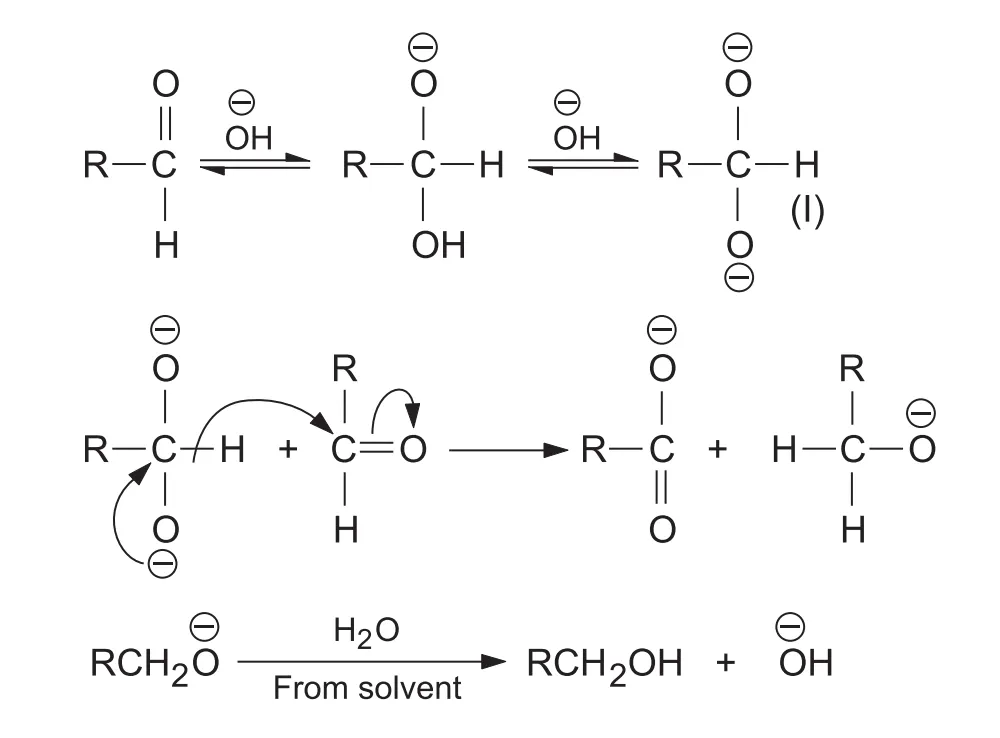
Fig. 1 — General Cannizzaro Mechanism (RCHO): OH¹² addition → hydride transfer → alcohol + carboxylate
Step 1 — Nucleophilic Addition of OH¹² (Fast, Reversible)
The hydroxide ion (OH¹²) attacks the electrophilic carbonyl carbon, producing a tetrahedral alkoxide intermediate (I):
This step is fast and reversible. Intermediate (I) carries a hydride (H¹²) that is now primed for transfer to another aldehyde molecule.
Step 2 — Intermolecular Hydride (H¹²) Transfer (Slow — Rate-Determining Step)
Intermediate (I) donates its hydride ion (H¹²) to the carbonyl carbon of a second unreacted aldehyde. The C–H bond breaks heterolytically — both electrons migrate as H¹² to the second molecule:
This is the rate-determining step — the only slow step in the entire mechanism.
What happens: Intermediate (I) becomes a carboxylate (C=O reforms as both electrons return to O). The second aldehyde receives H¹² at its carbonyl C and becomes an alkoxide (RCH⊂2O¹²).
Step 3 — Proton Transfer from Water (Fast)
The alkoxide (RCH⊂2O¹²) is a strong base. It abstracts a proton from the water solvent to give the primary alcohol, regenerating OH¹²:
Benzaldehyde-Specific Mechanism (Image 2)
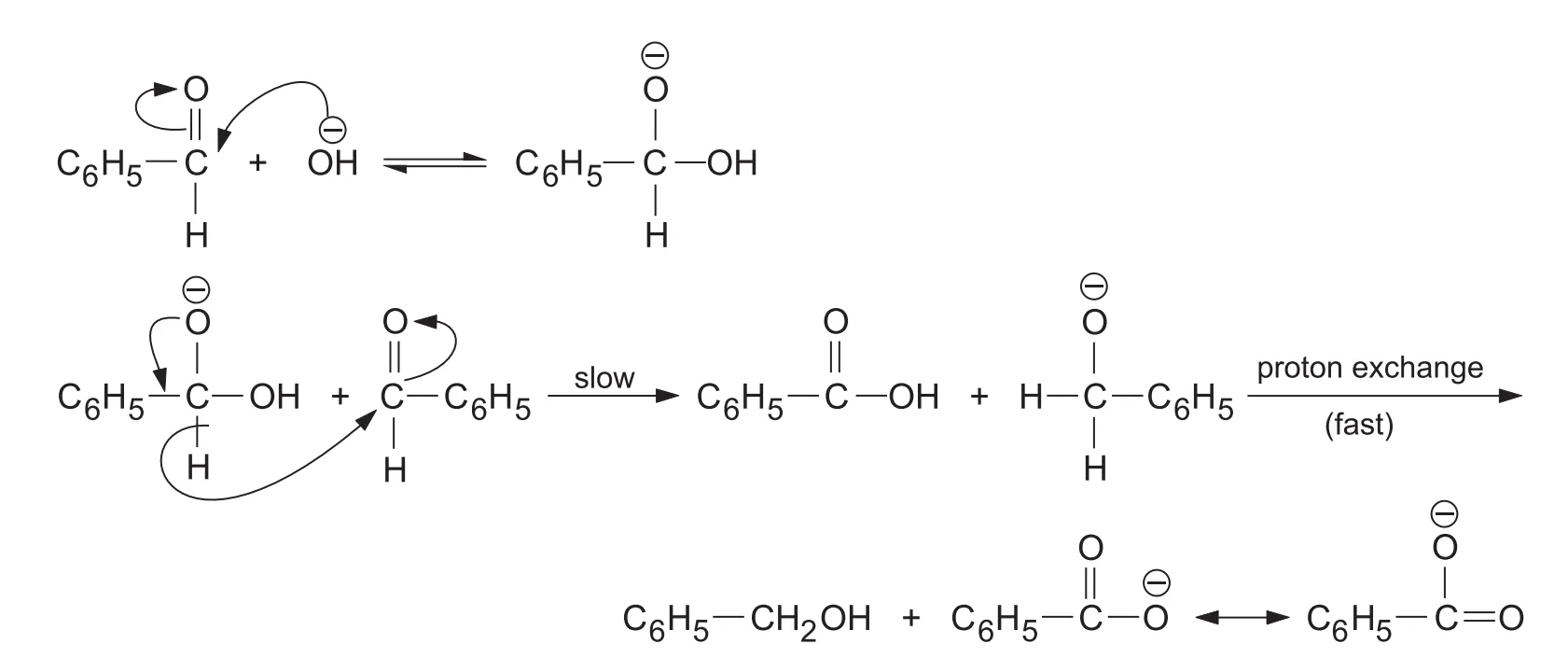
Fig. 2 — Benzaldehyde Cannizzaro Mechanism: slow hydride transfer step and proton exchange giving benzyl alcohol + sodium benzoate
4. Standard Cannizzaro Reactions — Products Table
| Aldehyde | Equation | Alcohol | Salt |
|---|
| Formaldehyde (HCHO) | 2 HCHO + NaOH → | CH⊂3OH (Methanol) | HCOONa (Sodium formate) |
| Benzaldehyde (C⊂6H⊂5CHO) | 2 C⊂6H⊂5CHO + NaOH → | C⊂6H⊂5CH⊂2OH (Benzyl alcohol) | C⊂6H⊂5COONa (Sodium benzoate) |
| Chloral (CCl⊂3CHO) | 2 CCl⊂3CHO + NaOH → | CCl⊂3CH⊂2OH (Trichloroethanol) | CCl⊂3COONa (Sodium trichloroacetate) |
5. Crossed Cannizzaro Reaction
When two different non-enolisable aldehydes are treated together with NaOH, a Crossed Cannizzaro reaction occurs. The reaction is selective:
Crossed Cannizzaro with Formaldehyde (Most Important Case)
HCHO is always preferentially oxidised to formate (HCOONa); RCHO is reduced to the primary alcohol.
Why HCHO Preferentially Acts as Hydride Donor
- Maximum electrophilicity: HCHO is the most reactive aldehyde towards nucleophilic attack — OH¹² adds fastest to it.
- Stability of formate: HCOONa is resonance-stabilised and thermodynamically very stable.
- No steric hindrance: HCHO has no alkyl substituents at carbonyl carbon.
Industrial Application — Pentaerythritol Synthesis
The final step in making pentaerythritol uses a crossed Cannizzaro:
6. Intramolecular Cannizzaro Reaction
When a molecule contains two aldehyde groups with no alpha-H, the reaction occurs within the same molecule. One –CHO is oxidised and the other is reduced.
Example — Glyoxal:
(Glyoxal → Sodium glycolate)
Intramolecular Cannizzaro is particularly facile because the hydride transfer is within a single molecule — entropically favoured over the intermolecular version.
Practice Questions (JEE / NEET Level)
Q1 (1 mark): Which of the following will NOT undergo Cannizzaro reaction with NaOH?
A) HCHO
B) C6H5CHO
C) CH3CHO
D) (CH3)3CCHO
Answer: C) CH3CHO (Acetaldehyde).
Explanation: The essential condition for a Cannizzaro reaction is the absence of alpha-hydrogen atoms. Acetaldehyde (CH3CHO) possesses 3 alpha-hydrogens on its methyl group. When treated with a base like NaOH, the base will preferentially abstract the acidic alpha-proton to form an enolate ion, leading to an Aldol condensation. All the other options (Formaldehyde, Benzaldehyde, and Pivaldehyde) lack alpha-hydrogens and therefore must undergo the Cannizzaro disproportionation reaction.
Q2 (2 marks): Write the products when benzaldehyde is treated with concentrated NaOH. Name the reaction type.
Explanation:
Reaction Type: Cannizzaro Reaction (which is a redox disproportionation reaction).
Reaction:
Products: Because benzaldehyde lacks alpha-hydrogens, one molecule is reduced to an alcohol, and the other is oxidized to a carboxylic acid salt. The products are Benzyl alcohol (C6H5CH2OH) and Sodium benzoate (C6H5COONa) produced in a 1:1 molar ratio.
Q3 (3 marks): In a crossed Cannizzaro reaction between HCHO and C6H5CHO in concentrated NaOH, which molecule is oxidized and which is reduced? Write the overall reaction and explain why HCHO preferentially acts as the hydride donor.
Explanation:
Reaction:
Oxidized: Formaldehyde (HCHO) is oxidized to Sodium formate (HCOONa).
Reduced: Benzaldehyde (C6H5CHO) is reduced to Benzyl alcohol (C6H5CH2OH).
Why HCHO acts as the hydride donor (oxidized):
1. Reactivity: Formaldehyde has no bulky alkyl/aryl groups and no electron-donating inductive effects, making its carbonyl carbon highly electrophilic. The OH&supmin; nucleophile from the base attacks HCHO much faster than it attacks benzaldehyde.
2. Stability: The resulting formate ion (HCOO&supmin;) is highly resonance-stabilized and thermodynamically favorable.
Q4 (2 marks): What is the rate-determining step in the Cannizzaro reaction? Describe what happens during this step.
Explanation:
Rate-determining step (RDS): The Intermolecular Hydride (H&supmin;) Transfer.
Description: In step one, the hydroxide ion attacks the aldehyde to form a tetrahedral alkoxide intermediate. During the slow RDS, this intermediate collapses to re-form the carbonyl pi-bond, which forces the C–H bond to break heterolytically. Both electrons of the C–H bond migrate as a hydride ion (H&supmin;) and attack the electrophilic carbonyl carbon of a second, unreacted aldehyde molecule. This step is slow because it is a bimolecular collision requiring highly precise orbital overlap between the two reacting molecules.
Q5 (MCQ): Glyoxal (OHC–CHO) on treatment with concentrated NaOH gives:
A) Glycol + oxalate
B) Sodium glycolate
C) Glyoxylic acid
D) Oxalic acid
Answer: B) Sodium glycolate.
Explanation: Glyoxal is a dialdehyde with no alpha-hydrogens. Therefore, it undergoes an intramolecular Cannizzaro reaction. One aldehyde group acts as the hydride donor (and is oxidized to a carboxylate salt group, –COO&supmin;), while the adjacent aldehyde group acts as the hydride acceptor (and is reduced to an alcohol group, –CH2OH) entirely within the same molecule:
(Sodium glycolate)
Q6 (2 marks): Explain why CH3CHO does not undergo the Cannizzaro reaction with NaOH, whereas HCHO does.
Explanation:
CH3CHO (Acetaldehyde): Contains an alpha-carbon with three acidic alpha-hydrogen atoms. When exposed to a strong base like NaOH, the base abstracts an alpha-proton to form a resonance-stabilized enolate ion. This enolate immediately attacks another acetaldehyde molecule to initiate an Aldol condensation. The kinetics of the acid-base proton transfer in the Aldol pathway are vastly faster than the nucleophilic addition required for Cannizzaro.
HCHO (Formaldehyde): Has no alpha-carbon and thus zero alpha-hydrogens. Since the Aldol pathway is structurally impossible, the only reaction pathway available is the nucleophilic addition of OH&supmin; to the carbonyl carbon followed by hydride transfer—which is the exact mechanism of the Cannizzaro reaction.
Q7 (JEE-type): A deuterium-labeling experiment uses R–CDO as the second aldehyde in a Cannizzaro reaction alongside an unlabeled aldehyde (R–CHO). The isolated alcohol product is found to be R–CHDOH (not R–CH2OH). What mechanistic conclusion does this experimental outcome support?
Explanation:
Conclusion: This confirms the direct, intermolecular hydride transfer mechanism.
If R–CDO is used as the hydride acceptor, the deuterium (D) is already attached to the carbonyl carbon. When the hydride (H&supmin;) from the unlabeled tetrahedral intermediate is transferred over, it attacks this specific carbon. The resulting alkoxide is R–(D)(H)CO&supmin;, which after aqueous workup yields the alcohol R–CHDOH.
This isotopic labeling proves two critical things:
1) The new hydrogen atom attached to the alcohol carbon comes directly from the C–H bond of the oxidized aldehyde molecule, NOT from the aqueous solvent.
2) The transfer occurs as a concerted, direct shift between two molecules, completely ruling out any stepwise or free-radical mechanism involving the solvent.