1. About the Report
Publishers and Frequency
- The GHI is calculated annually and is issued in October each year.
- It is published jointly by European NGOs: Welthungerhilfe (Germany) and Concern Worldwide (Ireland).
2. Calculation Methodology & Indicators
The GHI Scoring Scale
The GHI determines hunger on a 100-point scale where 0 is the best possible score (no hunger) and 100 is the worst. Each country's score is classified by severity.
- Low: ≤ 9.9
- Moderate: 10.0 - 19.9
- Serious: 20.0 - 34.9
- Alarming: 35.0 - 49.9
- Extremely Alarming: ≥ 50.0
Four Component Indicators
GHI scores are based on the values of four component indicators:
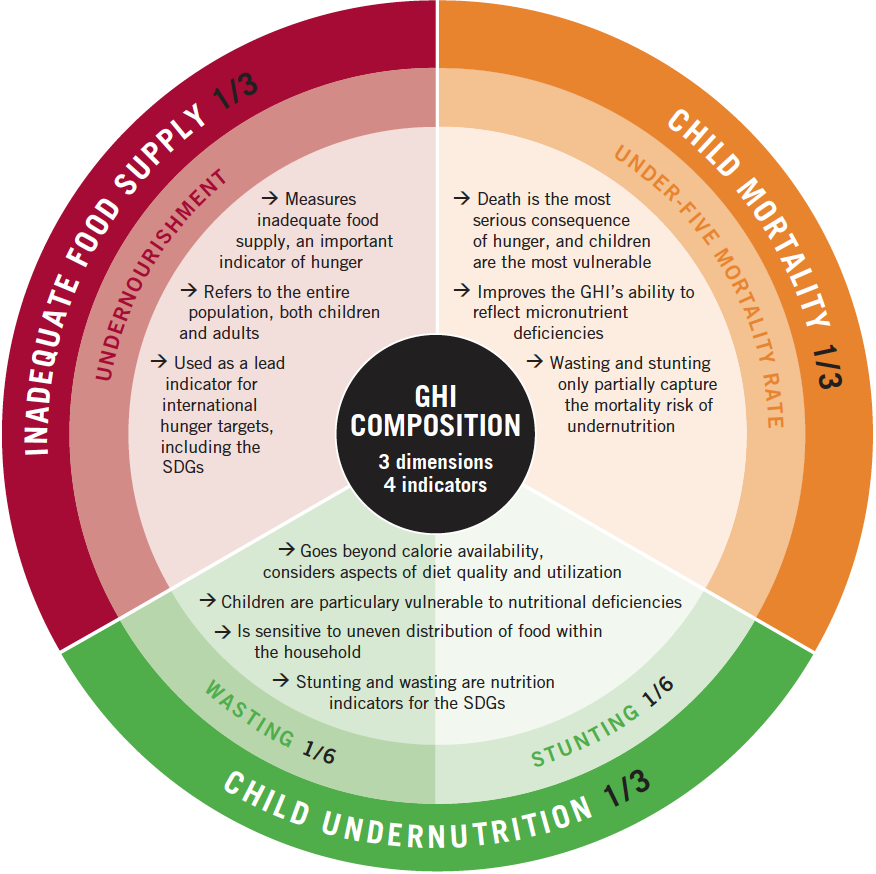
Image Credit: globalhungerindex.org
- 1. Undernourishment: Share of the population with insufficient caloric intake (reflects inadequate food supply).
- 2. Child Wasting: Share of children under age five who have low weight for their height, reflecting acute undernutrition.
- 3. Child Stunting: Share of children under age five who have low height for their age, reflecting chronic undernutrition.
- 4. Child Mortality: The mortality rate of children under the age of five (reflects the fatal mix of inadequate nutrition and unhealthy environments).
Data Sources
- Undernourishment: Food and Agriculture Organization (FAO).
- Child Mortality: UN Interagency Group for Child Mortality Estimation (UN IGME).
- Child Wasting & Stunting: Joint database of UNICEF, the World Health Organization (WHO), and the World Bank.
3. Critical Analysis (UPSC Perspective)
Government of India's Criticism of GHI
India frequently ranks low on the GHI (e.g., 111th out of 125 countries in 2023). The Ministry of Women and Child Development often rejects the report citing methodological flaws:
- Disproportionate Focus on Children: Three out of the four indicators (wasting, stunting, mortality) are related solely to children under five, which cannot be representative of the entire population.
- Opinion-based Data: The "Undernourishment" indicator relies partly on the FAO's Food Insecurity Experience Scale (FIES), which the government argues is based on a small sample size opinion poll (Gallup World Poll) rather than hard data.
- Ignorance of Government Interventions: The index often fails to capture the massive scale of food security interventions like the PM Garib Kalyan Anna Yojana (PMGKAY).
Steps Taken by India to Tackle Hunger
- National Food Security Act (NFSA), 2013: Legally entitles 75% of the rural and 50% of the urban population to receive highly subsidized foodgrains.
- POSHAN Abhiyaan (National Nutrition Mission): Targets reduction in stunting, under-nutrition, anemia, and low birth weight.
- PM Garib Kalyan Anna Yojana: Free food grains provided to millions during and post the COVID-19 pandemic.
- Fortification of Rice: Supplying iron, folic acid, and vitamin B-12 fortified rice through the Public Distribution System (PDS) to combat hidden hunger (micronutrient deficiency).