Definition and Purpose
Escrow is commonly associated with real estate transactions, but it can be used in any scenario where funds are transferred from one party to another. With real estate, escrow can be used when purchasing a home or for the life of a mortgage. The use of escrow has been on the rise as a way to offer secure transactions for high-ticket items, such as stocks, art, jewellery, antiques or intellectual property like software source code.
Escrow Transaction Flow
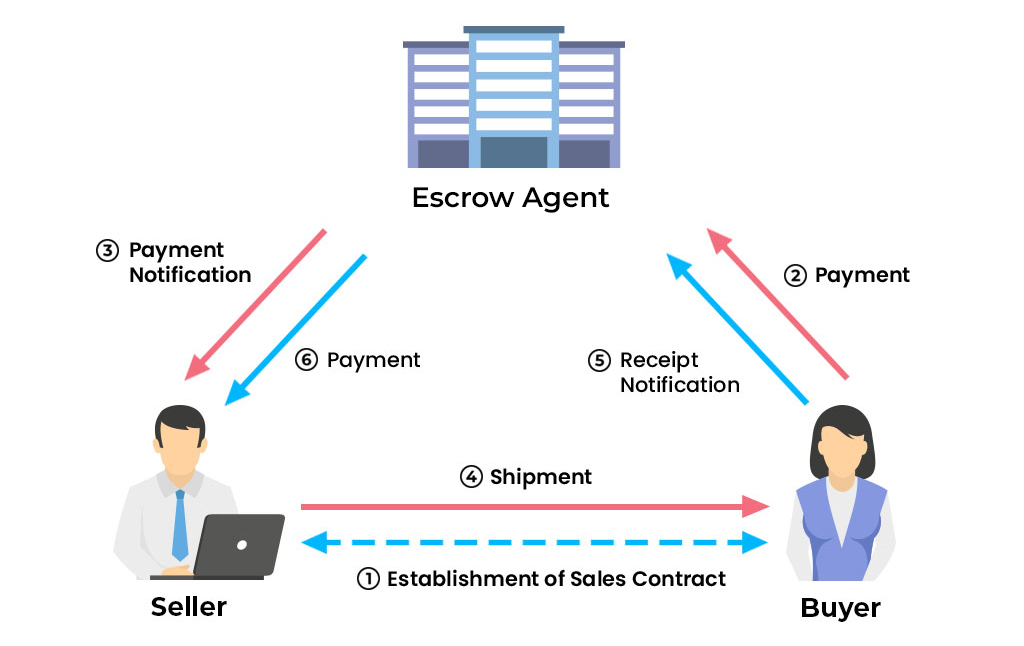
Escrow Transaction Flow Diagram
Step-by-Step Process
Step 1: Agreement
Buyer and Seller agree to the terms and conditions of the transaction.
Step 2: Fund Deposit
The Buyer deposits funds into the escrow account.
Step 3: Notification
The escrow agent informs the Seller that money has been deposited into the Escrow account.
Step 4: Delivery/Service
Seller ships the product to the Buyer or performs the requested service.
Step 5: Receipt Confirmation
The Buyer receives the product or service and confirms satisfaction.
Step 6: Fund Release
The escrow agent releases funds to the Seller from the escrow account.
Types of Escrow Accounts in Indian Banking
1. Real Estate Escrow
Used in property transactions to hold earnest money, down payments, and closing costs until all conditions are met.
Example: A buyer deposits ₹10 lakh in escrow while purchasing a property. The money is released to the seller only after title verification and completion of all legal formalities.
2. Mortgage Escrow
Banks collect additional monthly payments for property taxes and insurance, holding them in escrow until these bills are due.
Example: A home loan borrower pays an extra ₹5,000 monthly into escrow for property tax and insurance premiums.
3. Business Transaction Escrow
Used in mergers, acquisitions, and large business deals to ensure compliance with terms before fund transfer.
4. Online Transaction Escrow
Digital platforms use escrow services for high-value online purchases to protect both buyers and sellers.
Regulatory Framework in India
Reserve Bank of India (RBI) Guidelines
RBI regulates escrow accounts under the Banking Regulation Act, 1949. Banks must maintain proper documentation and comply with KYC norms for escrow account holders.
SEBI Regulations
For securities transactions, SEBI (Securities and Exchange Board of India) has specific guidelines for escrow accounts used in IPOs and other capital market transactions.
Real Estate (Regulation and Development) Act, 2016 (RERA)
RERA mandates developers to deposit 70% of funds received from buyers in a separate escrow account to be used only for construction of that particular project.
Benefits of Escrow Accounts
For Buyers
- Security: Funds are protected until goods/services are delivered as agreed
- Dispute Resolution: Neutral third party can mediate in case of conflicts
- Quality Assurance: Payment is released only after satisfaction
- Legal Protection: Formal documentation protects legal interests
For Sellers
- Payment Guarantee: Assurance that buyer has funds available
- Reduced Risk: Protection against payment defaults
- Professional Handling: Third-party management reduces administrative burden
- Trust Building: Increases buyer confidence in transactions
Escrow Account Features
Key Characteristics
- Neutral Third Party: Escrow agent must be independent of both parties
- Conditional Release: Funds released only upon meeting predetermined conditions
- Documentation: All terms and conditions must be clearly documented
- Time-bound: Usually has specific timelines for completion
- Interest Bearing: May earn interest depending on account type and duration
Common Applications in Indian Context
1. Infrastructure Projects
Government contracts often use escrow accounts to ensure proper fund utilization and project completion.
2. Import-Export Transactions
International trade transactions use escrow to mitigate risks associated with cross-border payments.
3. IPO and Capital Market
Companies going public deposit IPO proceeds in escrow accounts until listing requirements are met.
4. Insurance Claims
Large insurance settlements may be held in escrow pending final documentation and approvals.
Challenges and Limitations
Cost Factor
Escrow services involve fees that may range from 0.5% to 2% of the transaction value, making them expensive for small transactions.
Time Delays
The verification and approval process can delay transactions, especially in time-sensitive deals.
Limited Availability
Not all banks offer comprehensive escrow services, particularly for specialized transactions.
Digital Transformation
Fintech Integration
Modern escrow services are increasingly digitized with features like:
- Online account opening and management
- Real-time transaction tracking
- Automated condition verification
- Digital documentation and signatures
- Integration with payment gateways